River Heights
The Hidden StaircaseRiver Heights is a city in the Middle West and the home base of Nancy Drew and her father, Carson Drew. It anchors the story’s account of Carson’s legal reputation and the threat that Nathan Gombet’s accusations might damage it. Although the investigation takes Nancy away from home, River Heights remains the place to which the family’s concerns, public identities, and eventual return are connected.
Setting and civic identity
The narrative identifies River Heights as a city in the Middle West, not simply as a private household setting. Carson’s work there had made his name familiar beyond his immediate family: he had served as district attorney and built a strong professional reputation. That civic standing matters to the plot because Gombet’s threats are not limited to a personal quarrel. Nancy worries that if Gombet spreads his story around River Heights, people who do not know the facts may accept his accusations as true.
The town is therefore associated with both public judgment and local memory. Carson’s reputation has been earned through legal work, but the narrative also makes clear that such work has produced enemies as well as loyal friends. River Heights is where those opposing interests could converge: the place where Carson is known as a fighter, and where an unscrupulous accuser might try to turn that standing against him.
Carson Drew’s legal reputation
Before the central events, Carson’s work as a former district attorney had established him as a respected lawyer in River Heights. The story describes him as someone who had more than held his own against people willing to act without scruple. His professional identity gives Gombet’s allegations their potential force: false claims could still harm a reputation if repeated to listeners unable or unwilling to distinguish accusation from proof.
The dispute between the men has a specific legal and financial background. Carson explains that Gombet’s land had been condemned for a railroad right of way while Carson served on the land commission, and that he saw to it that Gombet was well paid. Gombet initially seemed satisfied, but after a bridge was built he sought additional compensation, arguing that it had damaged the remainder of his property. Carson regarded those later claims as unfounded. Gombet, by contrast, insisted that he had been cheated and demanded either the return of the deed or a higher price. The evidence does not establish that the land or bridge was in River Heights; the connection to the city is Carson’s public career and the local reputation that Gombet could threaten.
The Drew household as a home base
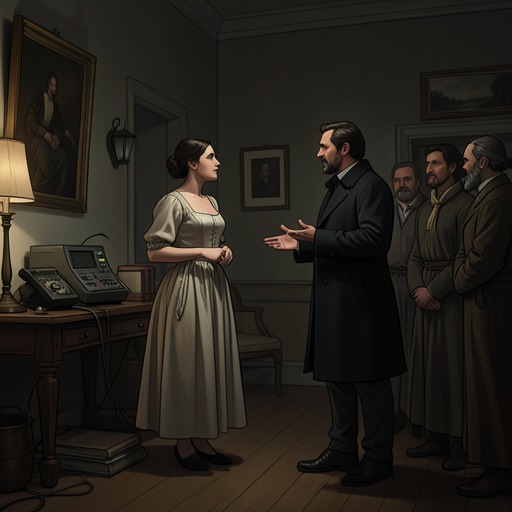
River Heights is also associated with the Drew household, where Nancy returns after a long day away and waits for her father’s evening train. At nearly six o’clock she reaches home, eats dinner, and grows impatient for Carson’s arrival. When he steps onto the veranda, she runs to meet him and tells him that an intimidating visitor has come looking for him. The domestic scene brings Gombet’s conflict into the family’s home and gives Nancy an immediate reason to fear that her father has acquired a dangerous enemy.
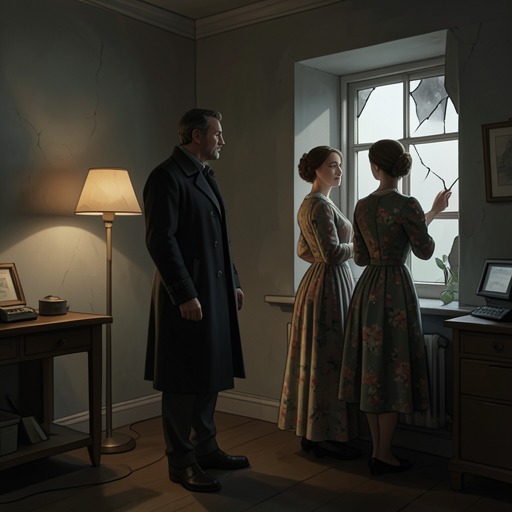
The encounter also connects the public dispute to Carson’s private papers. Gombet had rummaged in Carson’s desk in an effort to obtain the deed, then framed his demand as a claim to his rights. Nancy understands his earlier visit as an attempt to frighten her into surrendering papers. Her concern is twofold: Gombet may act against her father, and his false version of the land dispute may circulate among people in River Heights who know Carson only by reputation.
The town’s place in the resolution
River Heights remains an important point of reference even when the action moves elsewhere. The confrontation that leads to Carson’s rescue takes place at Gombet’s house in Cliffwood, not in River Heights. There, Carson later explains that Gombet had tricked him into coming to the house and had held him for several days while trying to force him to sign over money. The sheriff finds an agreement that would have required Carson to hand over a large sum and promise not to prosecute. These events expose the difference between Gombet’s language of rights and the coercive scheme he was actually pursuing.
Carson’s connection to River Heights also helps establish his standing with the authorities. When Nancy identifies herself as his daughter, the sheriff recognizes Carson as the lawyer from River Heights and responds differently to the request for action. Yet recognition alone does not initially satisfy the sheriff’s evidentiary standard: he says he cannot arrest Gombet without proof. The contrast places local reputation beside formal evidence, showing that public identity can open a conversation but cannot replace proof of guilt.
After Carson recovers, he says he must return to River Heights because his business has been neglected during the preceding week. Nancy and her father leave the Turnbull sisters’ home together, and Carson praises Nancy’s detective work on the journey. The return closes the geographical arc opened by Nancy’s arrival home and her report of Gombet’s first visit. River Heights thus frames the conflict: it is where Carson’s reputation is vulnerable, where Nancy first recognizes the threat to her family, and where their ordinary life resumes after the investigation has carried them elsewhere.